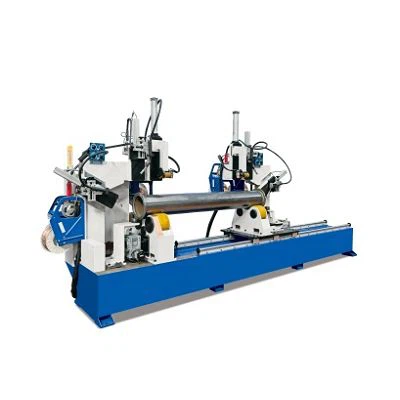
Dual-End TIG Welding System for Pipe Flange Welding Overview

The Automated Dual-End TIG Welding System is designed for pipe fabrication companies, industrial component manufacturers and production facilities that need to weld flanges to both ends of pipes efficiently and consistently. Equipped with two TIG welding torches, the machine can weld both pipe ends simultaneously while integrating automatic loading and unloading into the production process.
For manufacturers facing repetitive manual welding, time-consuming workpiece handling or inconsistent pipe-to-flange joint positioning, this system helps streamline production, reduce manual handling and improve process repeatability. It supports customised butt-joint and socket-joint welding configurations to accommodate different pipe and flange designs.
The machine can be customised according to pipe dimensions, flange specifications, joint types and production requirements, helping manufacturers build a more efficient and application-specific welding solution for flanged pipe assembly production.
Key Advantages for Pipe Flange Welding Manufacturers

- Simultaneous Welding at Both Pipe Ends
Two TIG welding torches allow the machine to weld flange connections at both ends of a pipe simultaneously. This arrangement can reduce the need to process each end in a separate welding cycle, subject to the workpiece geometry and approved welding procedure.
- Integrated Material Handling
Automatic loading and unloading help connect workpiece handling with the welding operation. The actual arrangement can be customised to the feeding direction, component dimensions and production layout.
- Flexible Joint Configurations
The system can be configured for butt-joint or socket-joint connections between pipes and flanges. Joint preparation, fixture design and welding parameters should be determined according to the selected workpiece and applicable welding requirements.
- Application-Specific Machine Design
Pipe length, outside diameter, flange dimensions and loading requirements can vary considerably between manufacturers. The machine can be engineered around the intended component range and production process.
How the Dual-End TIG Welding System for Pipe Flange Welding Process Works
STEP1: Automatic Feeding
The feeding system delivers the pipe into the designated welding position according to the configured loading arrangement.

STEP2:Component Positioning
The pipe and flange components are aligned and secured using dedicated fixtures designed for the selected joint configuration.

STEP3:Two-End TIG Welding
Both welding torches perform the configured welding operation at the two pipe ends simultaneously, helping streamline repetitive joining work.

STEP4: Automatic Unloading and observe
Once the welding cycle is complete and the machine permits removal, the unloading system transfers the finished assembly from the workstation.

See how a dual-torch TIG welding system automates the production of flanged pipe assemblies. The machine integrates automatic loading, simultaneous welding at both pipe ends and automatic unloading. Butt-joint and socket-joint configurations can be customised according to workpiece drawings and production requirements.
Butt-Joint and Socket Flange Welding Options
Different pipe assemblies require different connection designs. The appropriate machine configuration depends on the drawings, joint preparation and applicable welding procedure.
- Butt-Joint Welding
Used when the pipe end and flange connection are designed for a butt-joint configuration. The fixture and welding setup should match the specified joint preparation and alignment requirements.

- Socket-Joint Welding
Used for compatible socket-type connections in which the pipe is inserted into the flange socket before welding. The socket geometry and required weld details must be confirmed before machine design.

Supporting these two configurations can make the system relevant to a broader range of flanged pipe components. Whether both can be handled on the same machine without fixture changes depends on the final tooling and machine design.
Typical Applications
The system may be suitable for manufacturers producing:
- Industrial flanged pipe sections
- Pipe assemblies for process equipment
- Flanged components for industrial fluid systems
- Custom pipe connections with butt-joint or socket-joint designs
- Repetitive pipe-and-flange assemblies requiring automated handling
Actual application suitability should be confirmed against the workpiece material, joint specifications, dimensions and required weld quality.
Frequently Asked Questions
FAQ for Dual-End TIG Welding System for Pipe Flange Welding

01.Can both ends of a pipe be welded at the same time?
02.Does the system include automatic loading and unloading?
03.Can the equipment accommodate different pipe lengths and flange sizes?
04.Is TIG welding suitable for every pipe and flange material?
05.Can the machine handle both butt-joint and socket-joint connections?
06.What information is needed to request a quotation?
Provide pipe and flange drawings, material specifications, joint details, expected production volume and loading requirements. Sample photos or actual workpieces can also help clarify the application.
Hot Tags: automated dual-end tig welding system for pipe flange welding, manufacturers, suppliers, factory, price, for sale, Elbow Automatic Welding Machine, Flange Automatic Welding Machine, pipe flange welding machine, Pipe To Pipe Welding Machine